
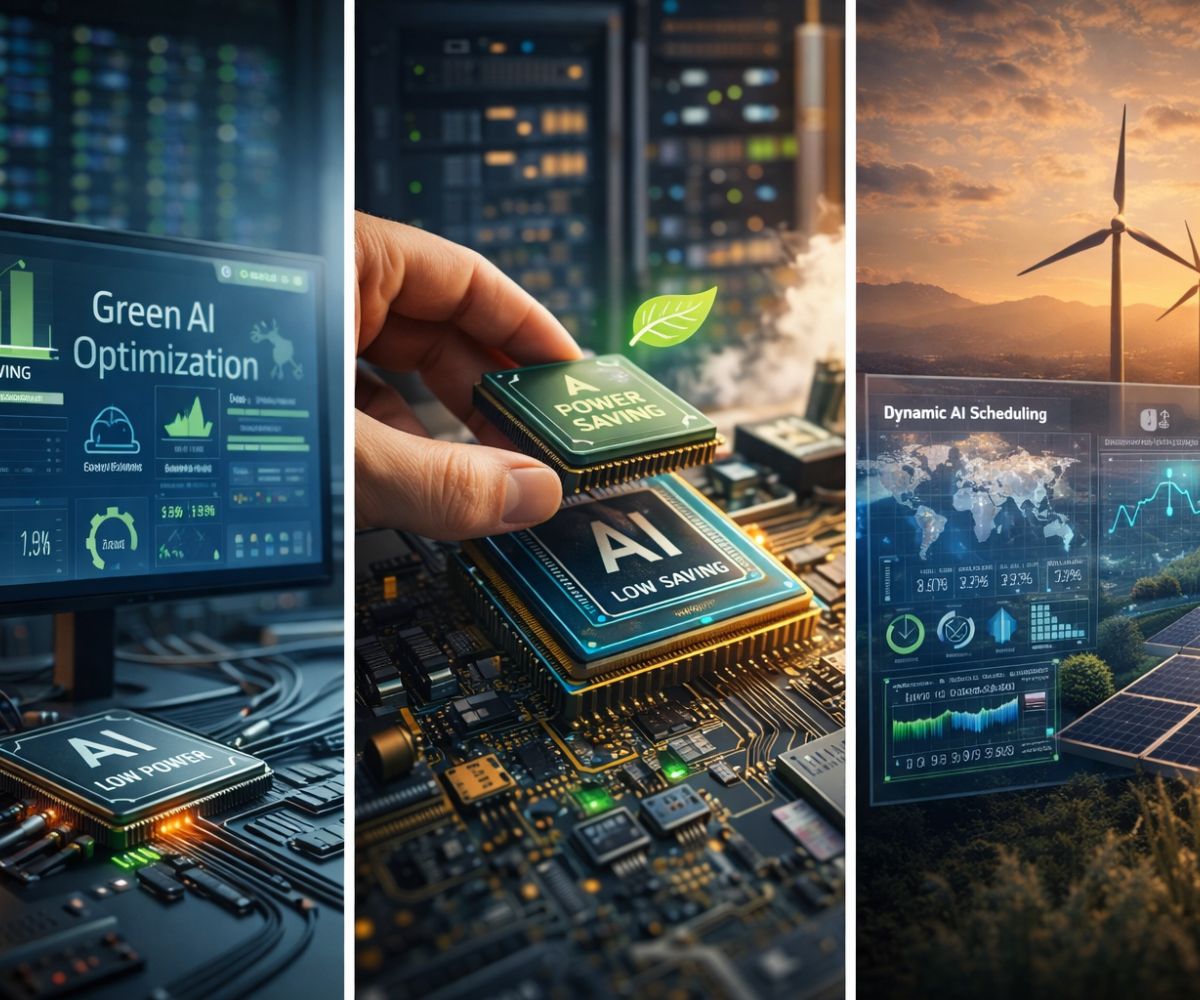
Your AI Systems Are Burning Money—And the Planet
If you’re running AI workloads, here’s an uncomfortable truth: you’re likely spending far more on compute and energy than necessary. But what if you could slash those costs by 70% while simultaneously reducing your environmental impact?
Welcome to Green AI—the operational revolution that’s transforming how smart organizations deploy artificial intelligence.
The Real Cost of Inefficient AI
Training large language models consumes energy equivalent to what 100+ U.S. households use annually. For enterprises running continuous AI operations, these costs compound rapidly:
- Skyrocketing electricity bills from 24/7 data center operations
- Water consumption for cooling infrastructure
- Premium prices for GPU access in capacity-constrained markets
- Growing compliance costs as environmental regulations expand
The solution isn’t to abandon AI—it’s to run it smarter.
Proven Techniques That Deliver 70% Efficiency Gains
1. Model Optimization: Pruning, Quantization, and Distillation
Pruning removes unnecessary neural network connections, reducing model size without significant accuracy loss. Think of it as trimming dead branches from a tree—the core structure remains strong while resource requirements plummet.
Quantization reduces the precision of model calculations. Instead of using 32-bit floating-point numbers, models can often operate effectively with 8-bit or even 4-bit precision, cutting memory and compute requirements dramatically.
Knowledge Distillation trains smaller “student” models to replicate the performance of larger “teacher” models. The result: comparable accuracy at a fraction of the computational cost.
Research from Accenture Labs and IIT Kharagpur demonstrates these techniques can reduce compute needs by up to 70%.
2. Dynamic Workload Orchestration
Smart organizations no longer run AI workloads on fixed schedules. Instead, they use dynamic orchestration based on real-time grid carbon intensity:
- Schedule training jobs during off-peak hours when renewable energy is abundant
- Shift geographically to data centers with cleaner energy sources
- Prioritize urgent inference tasks while queuing batch processing for optimal times
This approach simultaneously reduces costs (lower electricity prices during off-peak) and environmental impact.
3. AI-Optimized Hardware
The chip revolution is here. Purpose-built AI accelerators deliver:
- Higher performance per watt than general-purpose GPUs
- Reduced cooling requirements through efficient architecture
- Lower total cost of ownership over hardware lifecycle
Early adopters report 40-60% reductions in energy costs simply by migrating to optimized silicon.
Beyond Your Own Infrastructure: The AI-for-Energy Opportunity
Here’s where it gets exciting: AI isn’t just consuming energy—it’s revolutionizing how we generate, distribute, and optimize it.
Clean Energy Optimization
AI algorithms are improving power generation efficiency and grid management, reducing carbon emissions by up to 50% in pilot programs.
Predictive Maintenance
Machine learning models predict equipment failures before they occur, preventing energy waste from inefficient operations and extending asset lifespans.
Smart Grid Management
AI-powered grids balance supply and demand in real-time, integrating renewable sources more effectively and reducing waste.
The AI-in-energy market is projected to grow from $8.91 billion in 2024 to $58.66 billion by 2030—a massive opportunity for organizations that position themselves correctly.
Practical Implementation: Your 90-Day Green AI Roadmap
Unlock Premium Content
Subscribe to our newsletter to read the full article.