
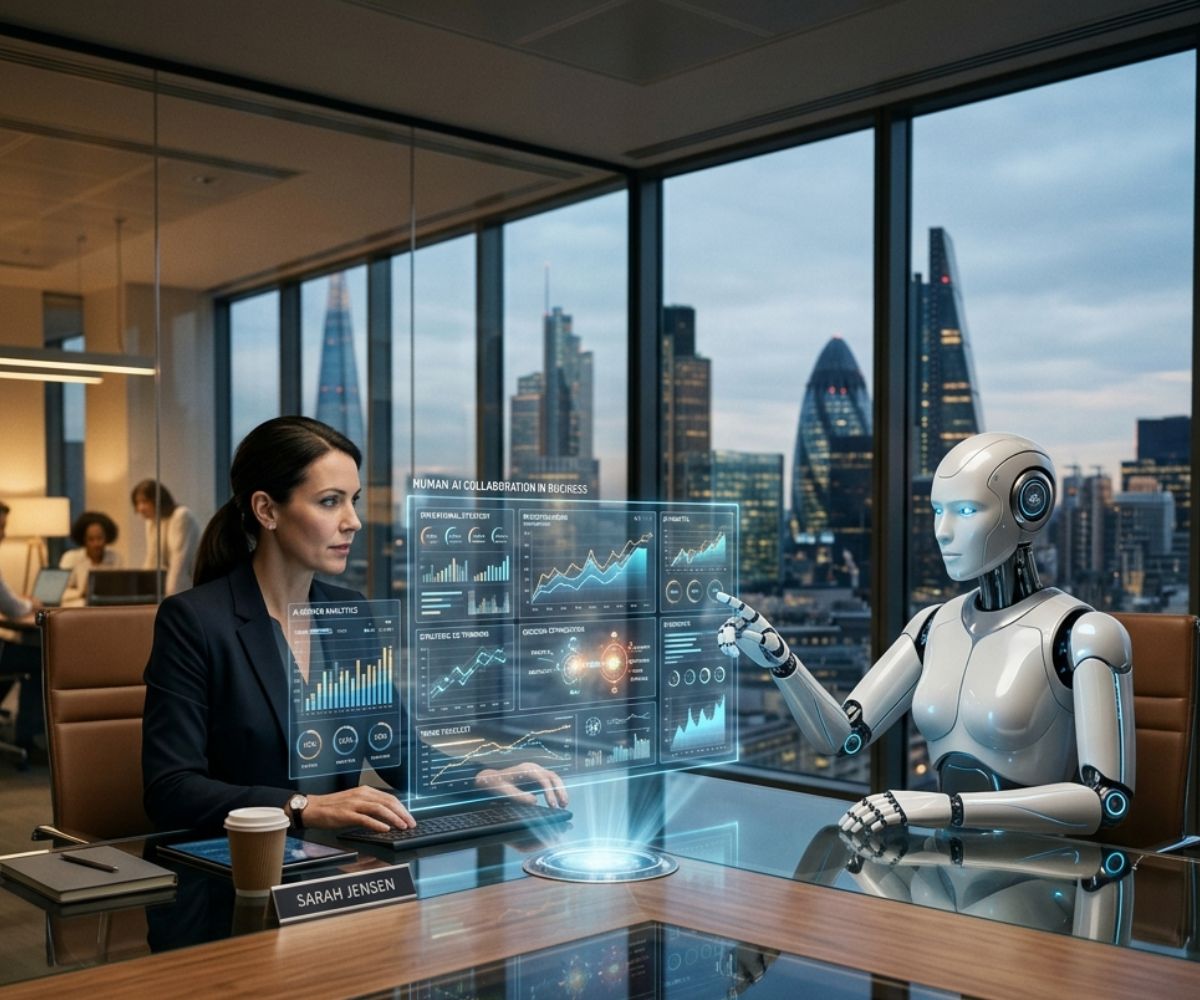
Moving Beyond Tools to Partnership
The existing narrative about AI tools is often reduced to just another type of tool. Examples include faster spreadsheets, smarter dashboards and better predictions; all of which are helpful – however, this perspective does limit the capability to realise the full benefit of using AI as part of an organisation’s ecosystem.
Some companies are beginning to see the use of AI as a true co-thinker instead of strictly a tool. This will not be through radical means, nor do these companies use AI in a dramatic or science fiction type of way, rather, they are simply leveraging it to explore potential campaigns and generate new ideas through a new lens, or running multiple what-if scenarios in an operational planning context, where this would have previously taken days to accomplish.
To quote one executive with whom we spoke, “It’s like having someone who never tires of asking, what if, to run ideas through,” which comfortably sums it up.
However, co-thinkers can create tension in some situations when organisations are sporting an evolving, co-thinking relationship with AI. Some may wonder if they are too dependent on AI, or where does human judgement fit into the decision-making process. These are valid concerns.
You might be interested in: Integrated C-Suite Collaboration: Moving Beyond Polite Alignment
Currently, the path to answering these questions seems to be through balance; AI can expand the horizons of possibilities and can provide new angles to old assumptions. However, AI, unlike humans, does not bring context to create relevance within corporate culture. For example, AI could be great at determining the efficiency of a schedule; however, if informal pathways of creating efficiencies are non-existent, human involvement is not only appreciated; it’s needed.
For example, a manufacturing plant was using AI to create operational schedules and while the system generated efficient schedules from a systems point of view on paper, there were informal pathways that existed to create efficiencies in the operations of the plant; without Human Development, AI was not able to create a successful schedule.
So, AI can be leveraged as a co-thinking entity to help create new ideas; however, AI is very much not an equal partner to humans; AI serves as a very capable assistant to broaden and provide additional perspectives on the situation at hand.
As a by-product of this transition; AI and therefore will likely produce sharper and clearer lines of thought vs. replacing them. The most interesting aspect of this transition isn’t necessarily what AI will do for us, but how it will transform how we think in the first place.